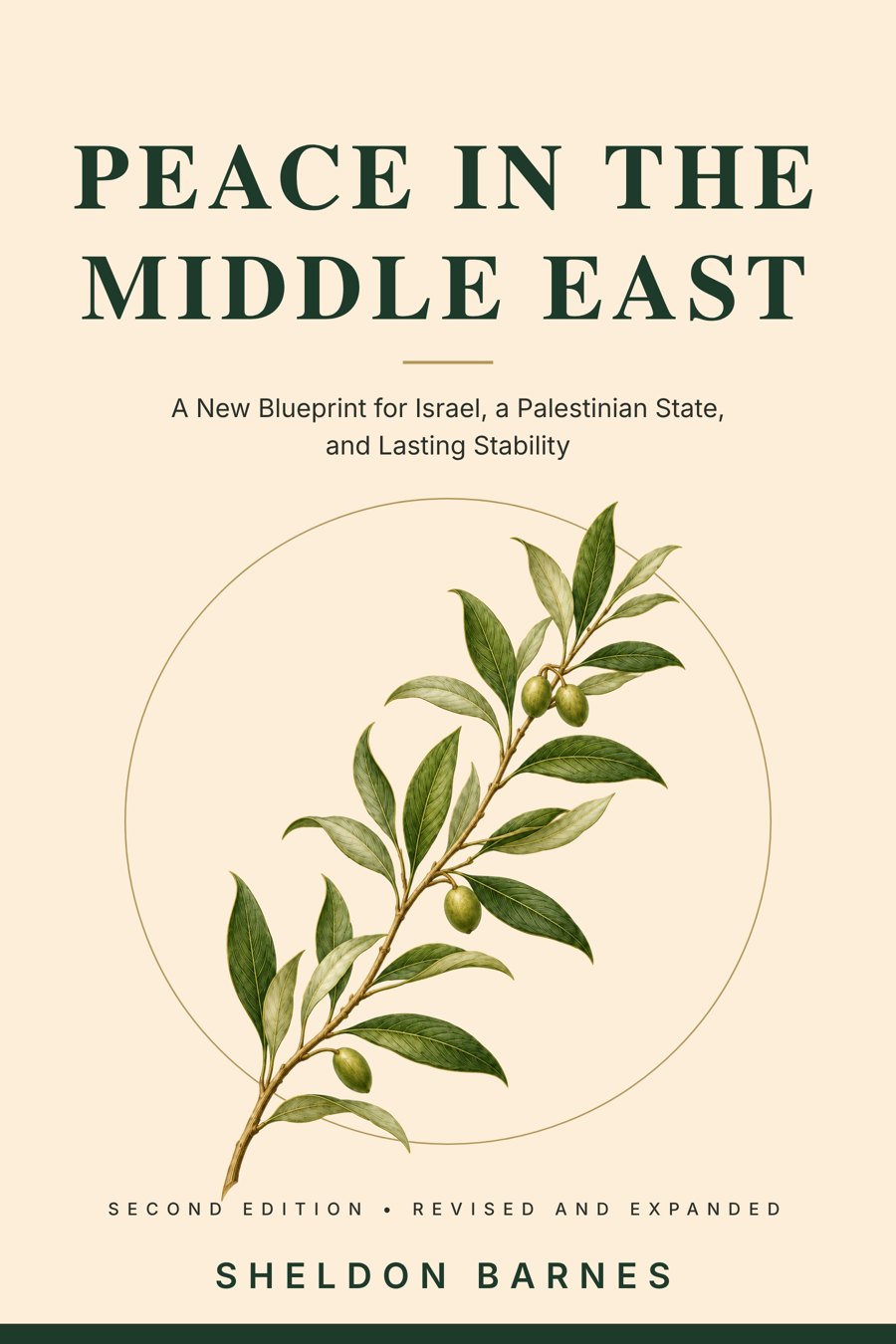
Peace in the
Middle East
A New Blueprint for Israel, a Palestinian State, and Lasting Stability
Second Edition • Revised and Expanded • Sheldon Barnes
Out now on KindleReleased on Veterans Day • Paperback coming soon
Peace feels distant. That does not mean it is impossible. For decades the world has watched the same cycle repeat: war, ceasefire, negotiation, collapse, and war again. This book argues that peace is still possible, a secure Israel, a sovereign Palestinian state, and a region with more to lose from war than to gain. But only if we stop solving the wrong problem.
The argument
Stop solving the wrong problem.
Peace in the Middle East is not another history of grievance or another partisan argument. It is a systems-level blueprint that explains why so many peace efforts have stalled, what the treaties that held got right, and what it would take to build something that lasts.
From the human cost borne by Israeli, Palestinian, Lebanese, Iranian, and Gulf civilians, to Israel's security needs, to the governance challenges facing a future Palestinian state, the book refuses easy answers. It takes seriously what both peoples need and the regional opportunity that survived 2026: the Abraham Accords, Gulf modernization, and a generation of leaders ready to build something new.
Then it lays out a concrete path: a regional security compact with real enforcement, disarmament in Lebanon, Gaza, Yemen, and Iraq at once, a standing offer to Iran, a Palestinian state inside the compact rather than outside it, and a prosperity engine the network cannot hold hostage.
"Peace is not out of reach. But it will not happen by accident. It must be designed."From the book
Four ways of seeing the conflict
The frameworks at the heart of the book
Each one is introduced in its own chapter, then used to read the 2026 war and to build the proposal that follows.
Chapter 3
The 3D World
The traditional order of Diplomacy, Defense, and Defeat: the default operating system of every Western foreign ministry, built for state actors who share an interest in survival. The book explains why it was designed for a conflict that no longer exists.
Chapter 5
The 3HI Proxy Network
The three H’s and the I: Hamas, Hezbollah, the Houthis, and Iran, which arms and finances them to differing degrees. The book models it as a franchise, with Tehran as the parent and the groups as franchisees of varying autonomy. Iraq’s Iran-aligned militias — Kataib Hezbollah, Asaib Ahl al-Haq, Harakat Hezbollah al-Nujaba — are a fourth front and an affiliate: Tehran’s money and direction, built on Lebanese Hezbollah’s name, template, and training. A peace that ignores the network gives every spoiler a veto, and the book argues it cannot be dismantled one franchise at a time.
Open the interactive guide: node by node, what has been done and what remains →
Chapter 6
The Octopus Doctrine
Iran is not a sponsor of terror; Iran is the head of an octopus, and the proxies are its tentacles. For forty years the West cut at tentacles and the tentacles grew back, because the brain was safe. Cutting tentacles is exercise, not strategy.
Interactive guides
The frameworks, brought to life
Companion pages built from the book's chapters and the public record, each with its sources stated and the limits of the evidence marked.
The 5D Reality
Deny, Delay, Defend, Disrupt, Doctrine: each D with dated cases, which of the three Ds it defeats, and a year strip from 1979 to 2026.
Open the guide → Chapters 5, 6, and 12The Axis of Resistance
Node by node: base, strength, equipment, leaders killed, what has been done since 2023, and what still stands at the cutoff.
Open the guide → History and court findingsDeath to America
Iran’s declaration of war against the United States: from the embassy seizure to lethal attacks and U.S. civil court judgments, with sources and attribution distinguished.
Read the record → Chapters 2, 5, and 12Four Decades of Attacks
A world map and timeline from Beirut in 1983 to Hormuz in 2026, filterable by node and decade, with how firmly each attribution stands.
Open the map → Chapters 6, 7, 9, and 14The Gaza Cycle
Five rounds since 2008, each with its toll by source, its pledges, and what came back, plus a schematic map of the reported tunnels and how well each claim holds.
Open the guide →Chapters 13 and 14
The Gulf-to-Gulf Accord
The proposed regional peace framework rests on five pillars that have to stand at the same time. The war of 2026 struck the head of the octopus with none of them in place, which is why confronting Iran was not enough on its own.
A regional security compact
Treaty-grade and multilateral, with a standing enforcement capability and triggers agreed in advance.
Disarmament at once
A single track running simultaneously in Lebanon, Gaza, Yemen, and Iraq, with an independent verification authority.
An Iran conversion pathway
A concrete, conditional offer of full regional membership, open to whichever Iranian government can deliver it.
A Palestinian state track
Integrated into the compact rather than negotiated in isolation, with a referendum and an inclusive voter register.
A prosperity engine
Built on regional integration, with redundancy around the Strait of Hormuz so no one can hold it hostage.
Months 0 to 6
Architecture
Summit, accord text, reconstruction fund, verification mechanism, Palestinian governance reform.
Months 6 to 12
The first hard tests
A security provocation, a verification violation, a financial disbursement, and a second summit with Iran invited on framework terms.
Months 12 to 24
The first visible goods
Economic projects, normalized commerce, and a calendared Palestinian political horizon.
Out now on Kindle
New in the second edition
The first edition was written before the war with Iran began. Every chapter has been revised in light of it, and the book has grown by a chapter and three appendices.
A full chapter on the 2026 war with Iran
From the closing of the Strait of Hormuz to the Islamabad Memorandum, the Lebanon front, the frozen Gaza ceasefire, and the American election that followed, ending with a pillar-by-pillar verdict on what the war did and what it skipped.
An implementation playbook with one calendar
Who acts, under what authority, at what cost, and what happens if a step fails.
A Palestinian political track in detail
An inclusive voter register, a referendum with separate questions on the constitution, the transitional authority, and the security mandate, and a humanitarian floor no penalty can touch.
A dated timeline, a glossary, and an implementation matrix
With the sources rechecked and the limits of that checking stated plainly. The timeline runs from October 7, 2023 to November 8, 2026, the book's cutoff date.
Inside the book
Five parts, fifteen chapters
The book moves from the stakes, to the system and the people inside it, to what the record teaches, to a proposal, and finally to a future that depends on choices still open.
Part I
The Stakes
Why a veteran of Iraq came to care about Palestine, and why the cost of the status quo is higher than the cost of trying.
- —Introduction: This Isn't Chaos
- 1Why Peace Still Matters
Part II
The System and the People Inside It
The four frameworks, then the people who pay for the system: civilians on every side, and an Israel kept permanently tired.
- 2The Illusion of Endless Conflict
- 3The World We Built (3D)
- 4The Reality We Face (5D)
- 5The 3HI Proxy Network
- 6The Octopus Doctrine
- 7The Human Cost
- 8Israel's Security Reality
Part III
What Peace Would Require, and What the Record Teaches
What a Palestinian state needs, the regional prize sitting on the table, why past efforts failed, and what the 2026 war proved and skipped.
- 9The Palestinian Future
- 10The Opportunity We're Missing
- 11Why Past Peace Efforts Failed
- 12Confronting Iran Was Not Enough New in this edition
Part IV
The Proposal
The Gulf-to-Gulf Accord and the boring middle: who does what, in what order, in the first two years.
- 13A New Framework for Peace
- 14The First 24 Months of Peace Implementation
Part V
A Conditional Future
Two visions for the region that cannot both win, and what the one worth choosing could look like.
- 15What a Future Could Look Like
- —Conclusion: Peace Is Possible
- —Afterword: Why I Wrote This Book
Back matter: notes and sources, a glossary, a one-page framework summary, a timeline from October 7, 2023 to November 8, 2026, and the implementation matrix.
Get the book
Read on Kindle or listen on Audible.
For readers who are tired of cynicism but unwilling to settle for slogans.
Second edition, revised and expanded. The Kindle edition was published on Veterans Day, November 11, 2026, by the author through Kindle Direct Publishing. Paperback and hardcover links will appear here as each listing goes live.
Press • For immediate release
“Peace in the Middle East” — second edition, out now on Kindle
A new blueprint for Israel, a Palestinian state, and lasting stability — rewritten after the war with Iran, the elections in Washington and Jerusalem, and a blockade that is still in force.
The second edition of Peace in the Middle East: A New Blueprint for Israel, a Palestinian State, and Lasting Stability was released on Kindle on Veterans Day, Wednesday, November 11, 2026. The paperback and hardcover editions will follow.
This is not a reprint. The first edition, published in April 2026, was written before the war with Iran began. Every chapter of this edition has been revised in light of what followed, and the book has grown by a full chapter and three appendices. Its research cutoff is November 8, 2026 — three days before it went on sale.
Governments change. The system that produces this war does not — unless someone redesigns it.From the release
Contact
Press and readers
Press and interviews
For review copies, interview requests, speaking, or excerpt permission, write to the author directly. Cover images and the book description are available on request.
press@peaceinthemiddleeastbook.comReaders
Corrections, disagreements, and questions about the frameworks are welcome. The second edition states the limits of its own source checking, and the author would rather hear about an error than leave it standing.
hello@peaceinthemiddleeastbook.com